Vampire-Bat Vocal Matching and Exchange Initiation
Active analysis
This page reports work in progress. Visualizations are used for exploratory analysis and hypothesis development; they do not independently demonstrate a communicative function.
Study objective
The project tests whether short-term acoustic matching predicts which vampire bat responds to an incoming call, whether the association is concentrated at exchange onset, and how calls subsequently transition through the social repertoire.
Caller assignment in group recordings
Group recordings require assignment of acoustic events to identified callers. When multiple bats can move and vocalize during the same interaction, a sound camera provides estimated source locations that can be aligned with synchronized video and used to associate calls with producing individuals.
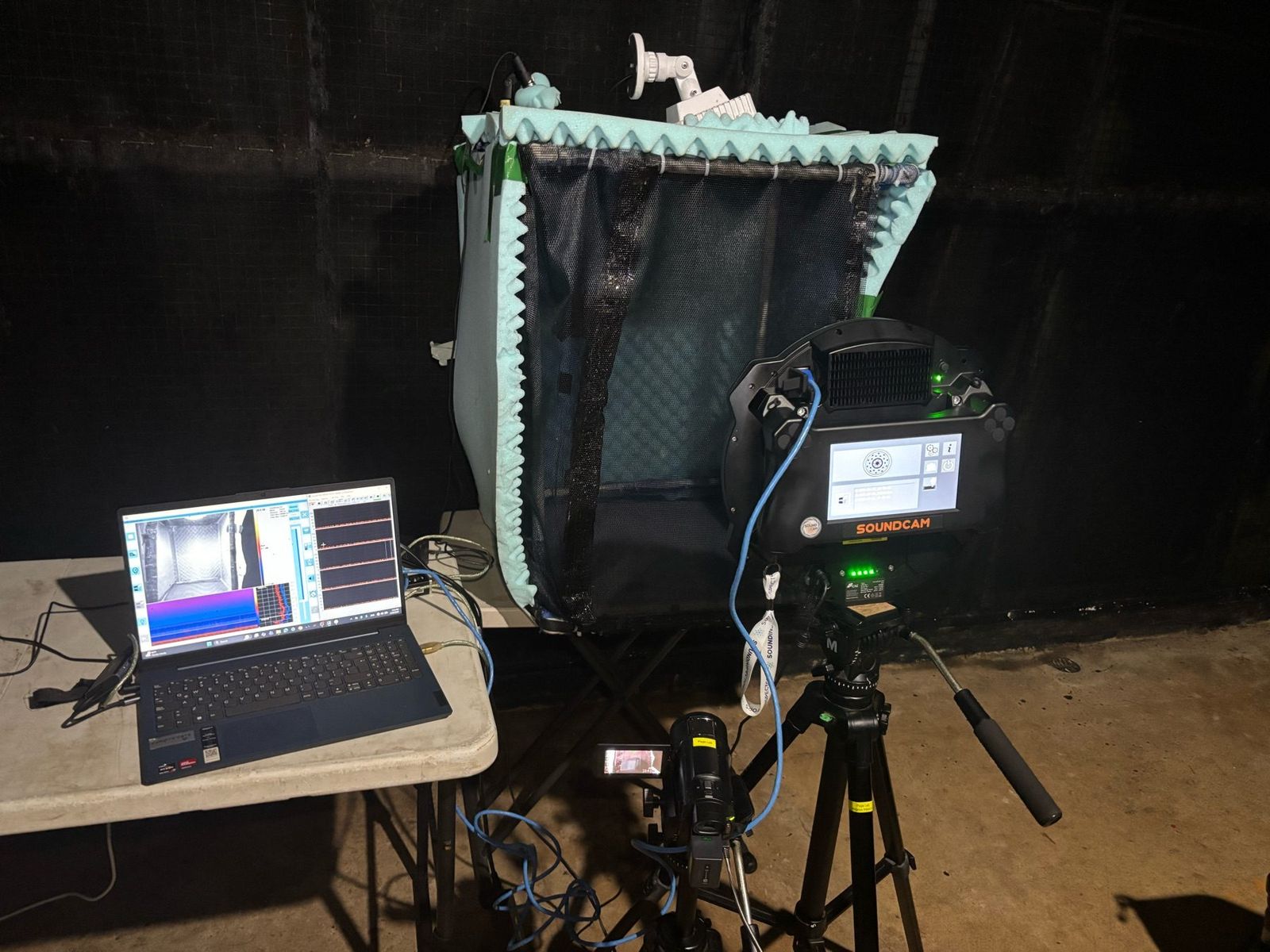
Outdoor sound-camera setup used for acoustic localization before calls are compared in an acoustic feature space. See the Panama field-season note for field and recording context. Gamboa, Panama · 2026
Candidate vocal-matching mechanism
An initial analysis of one dataset did not provide evidence for individual vocal labels. A preliminary response-timing analysis instead detected an association consistent with vocal matching: response probability increased when an incoming call was acoustically similar to the potential responder’s preceding calls.
The estimated association appears concentrated in particular provisional call types and near the beginning of calling bouts. The working hypothesis is that matching contributes to recipient selection or acknowledgement during exchange initiation and declines after an interaction is established. Playback analyses are in progress; the present observational result does not distinguish this account from shared context, arousal, temporal autocorrelation, or other alternatives.
Preliminary response analysis
A response was operationally defined as a call from another bat within five seconds. Acoustic distance was calculated as the minimum distance between the incoming call and the potential responder’s preceding three calls. The analysis currently includes two independently collected datasets:
- Princeton pairs: 8 female bats, 28 pairs, 84 recording hours, and 3,864 calls.
- Panama trios: 11 female and 6 male bats, 26 trios, 312 recording hours, and 140,913 calls.
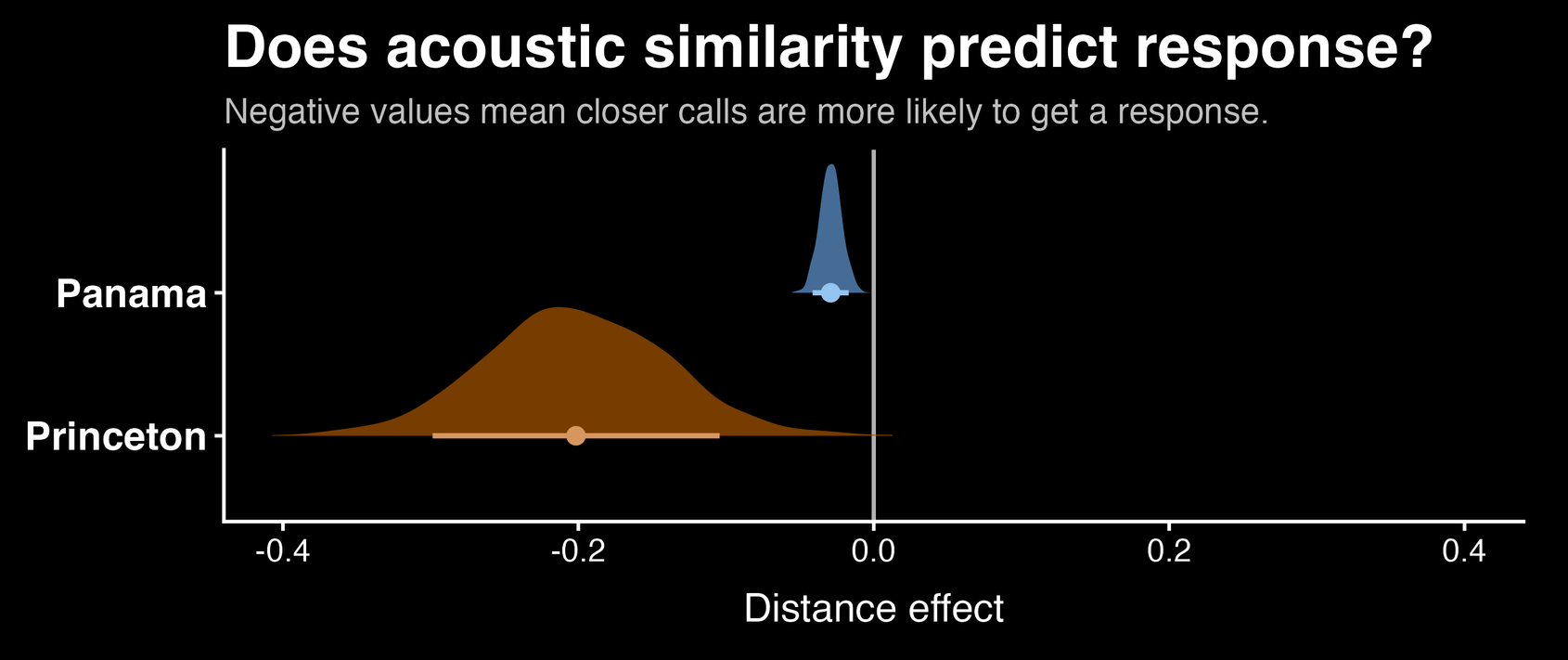
In both datasets, response probability within five seconds decreased as the acoustic distance between an incoming call and the potential responder’s recent calls increased. The estimated association is larger in the Princeton dataset. These models are preliminary; playback experiments and behaviour-linked analyses are required before interpreting the relationship as addressing or exchange initiation.
Preliminary call-type analyses suggest that the association is concentrated in a subset of provisional types and that several of those types occur relatively early in bouts. Category stability, model robustness, and function remain under active evaluation.
Acoustic-trajectory visualization
Coloured trajectories represent successive calls from three bats in a two-dimensional UMAP projection of LFCC features; corresponding spectrograms appear at right. Under a matching prediction, a new call should approach another bat’s recent position in the selected representation. The axes encode projected acoustic structure rather than physical location, and UMAP does not preserve all distances in the original feature space.
Operational definition of call categories
A complementary analysis evaluates how a continuously varying acoustic repertoire can be partitioned into operational call categories. Alternative feature representations and clustering procedures are compared rather than treating a single projection as a definitive taxonomy. Candidate categories must be stable across analytical choices and informative for predicting behaviour or sequence position.
Current tests
- Compare playback responses to candidate initiating calls and acoustically or contextually matched controls.
- Estimate interactions between acoustic distance, bout position, and provisional call type.
- Evaluate robustness across LFCC-based and alternative acoustic representations.
- Compare call-transition structure within and among social groups.
- Validate exploratory patterns with prespecified statistical models and held-out data where feasible.
Scientific significance
Analyses conducted at the level of isolated call types can miss recipient selection, response contingencies, and changes in signal use across an exchange. Modelling temporal position and candidate responders jointly provides a stronger test of exchange initiation and of whether analyst-defined call categories predict the bats’ observed interaction structure.
Research themes
Want to compare notes?
I am always happy to talk about response-timing models, playback design, acoustic representation learning, sequence analysis, or tests of socially learned call structure. A question or half-formed idea is enough reason to get in touch.