About Nakul
Why I study how animals “talk” to each other
The simplest description of my scientific interest is that I want to understand how animals “talk” to each other: what they communicate, how a signal is directed to a particular partner, what changes when calls are combined, and how individuals learn the vocal patterns of a pair or group.
I use talk as a broad, informal term rather than a claim that animal communication is equivalent to human language. A longer-term hope is that an experimentally grounded account of another species’ communication system could support a limited form of interspecies communication. Current research remains far from a genuine conversation, but several component questions are increasingly tractable: who produced a signal, who responded, which features vary with social context, and whether manipulating those features changes receiver responses.
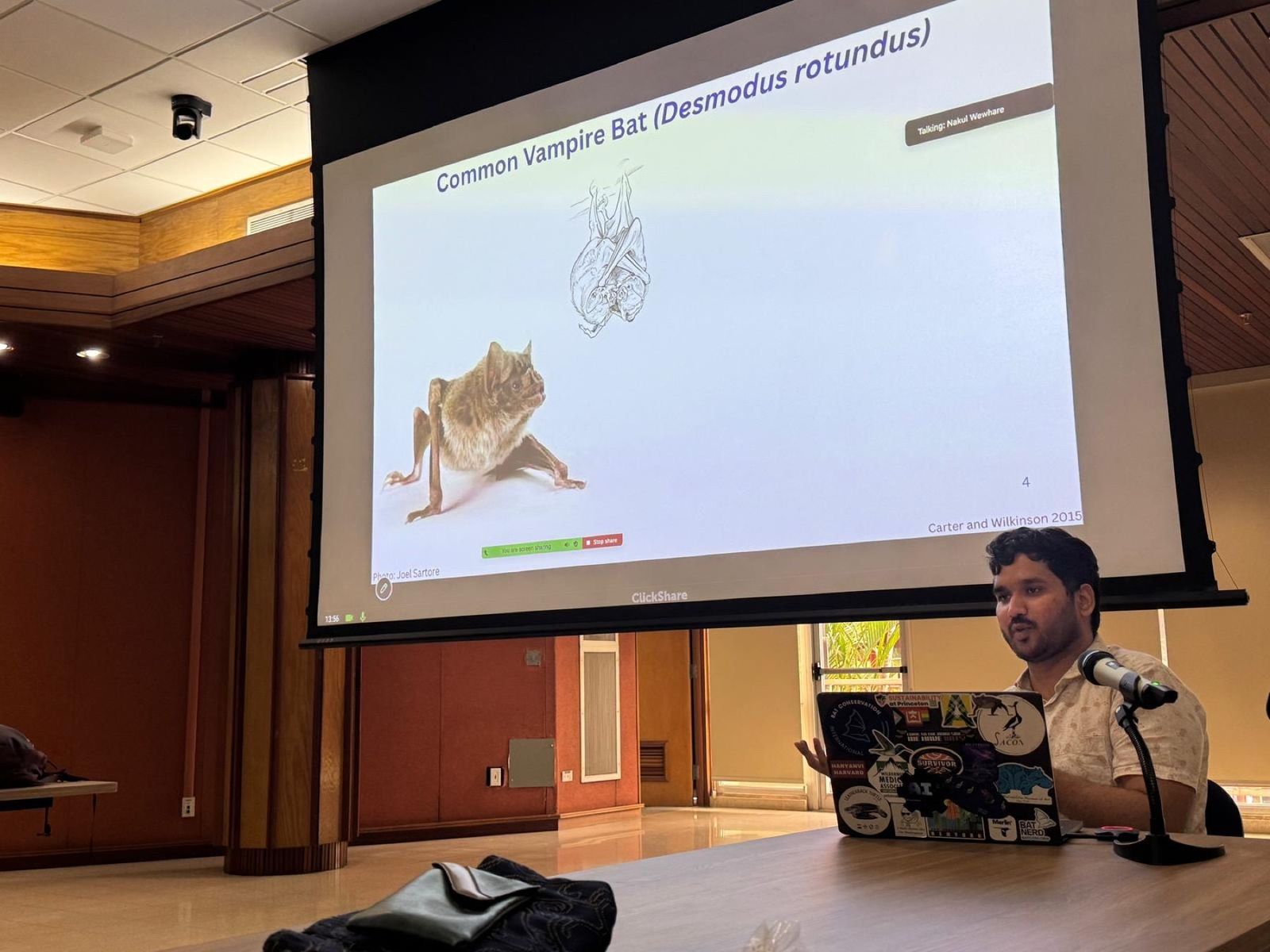
Speaking about vampire-bat research at a behaviour-group seminar in the Smithsonian Tropical Research Institute’s Tupper building, Panama.
Research questions
Animal communication is structured across several levels: calls occur within sequences, responses depend on particular partners, and vocal behaviour can change through social learning. My work therefore addresses both the information represented in vocal interactions and the validity of the methods used to infer that information.
Interactional and sequence structure
How are vocal exchanges initiated and maintained? Does acoustic matching predict directed responses? How do order, repetition, and timing alter the information available to a receiver?
Individual identity: signal or cue
Which acoustic correlates of caller identity arise incidentally from anatomy, and which are learned or maintained because receivers use them as identity signals?
Why bats
Bats are a strong comparative system because both perception and vocal production are highly specialized for acoustic behaviour, while their social communication remains less well characterized than echolocation. Common vampire bats are particularly useful because their cooperative behaviour, reciprocity, kinship, and long-term social relationships provide an unusually detailed behavioural framework for interpreting vocal interactions.
My doctoral research investigates vocal matching near the onset of calling bouts, non-random call combinations, population and group variation, and the potential social learning of sequence conventions. These are active analyses and experiments; proposed functions are presented as hypotheses and are separated from descriptive or correlational evidence.
Previous work
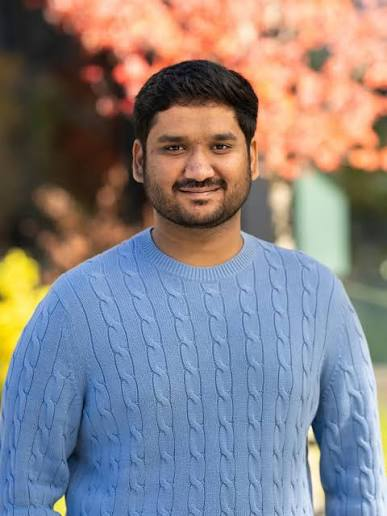
Before moving to vampire bats, I worked across field behaviour, automated experiments, computer vision, bioacoustics, and social-network analysis. Each project sharpened a different part of the same broad question: how animals use information and how social experience shapes behaviour.
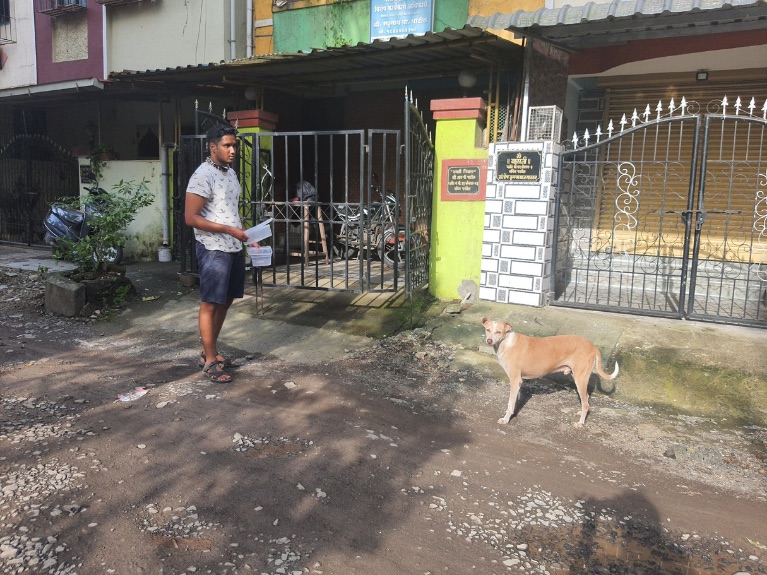
Field experiments · Mumbai
Sensory decisions in free-ranging dogs
With the Dog Lab at IISER Kolkata, I helped design and run field experiments testing how free-ranging dogs combine visual and olfactory information while scavenging. The resulting preprint has not yet been peer reviewed.
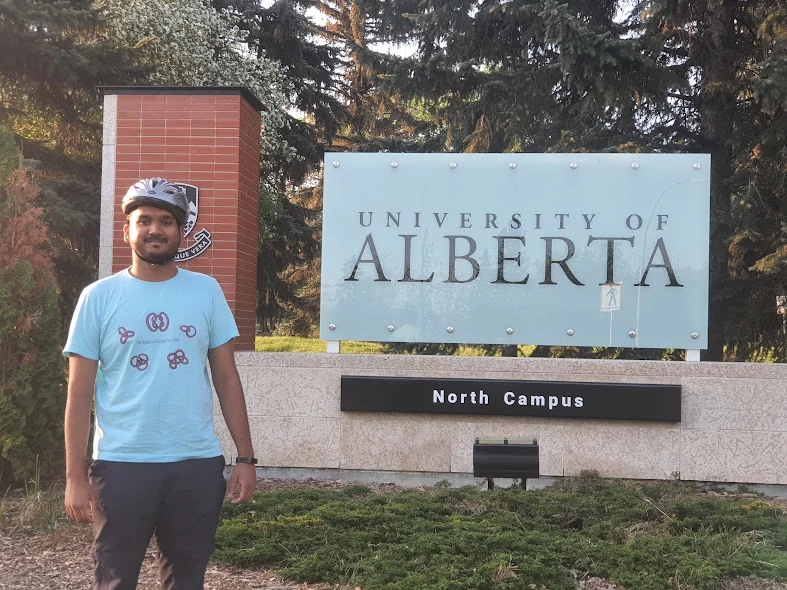
MITACS Globalink · 2023
Zebra-finch cognition in Canada
At the University of Alberta’s Animal Cognition Research Group, I ran zebra-finch nest-building experiments and developed DeepLabCut and AnimalTA workflows to quantify activity and personality-linked information use.
Rajan Lab · IISER Pune
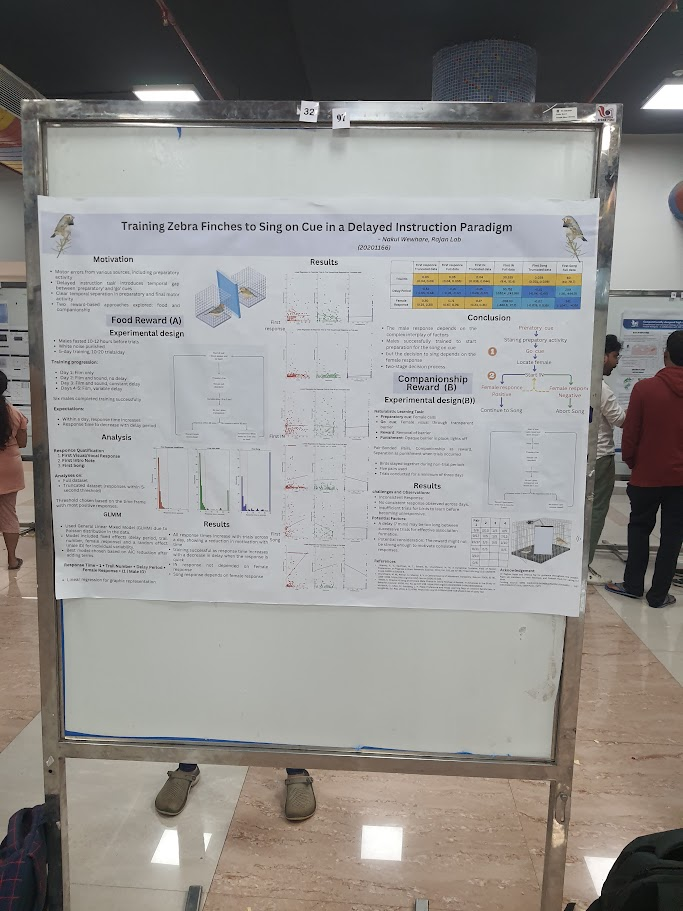
Preparing to sing on cue
I built a microcontroller-based training setup for a delay-instructed zebra-finch singing paradigm and assisted with electrophysiological recordings designed to separate preparation from song production.
Sequence analysis · manuscript in revision
Sequence convergence in common marmosets
I developed sequence-comparison methods to test how vocal organization changes after pair formation. The public preprint reports audience-dependent convergence in sequence structure, without clear convergence in individual phee-call acoustics.
Peer-reviewed study · 2024
Song and movement in budgerigar courtship
The clip shows a male directing warble song and repeated head and body movements toward a female. I analysed synchronized vocal and movement sequences from 100 courtship bouts; the study identified both broadly shared and individual-specific note–movement associations.
BS–MS thesis · 2024–2025
How I think about methods
Every acoustic representation emphasizes some dimensions of signal variation and suppresses others. LFCCs, MFCCs, spectro-temporal measurements, dynamic time warping, and variational autoencoders can therefore produce different similarity structures. I compare representations and validation criteria to determine which biological inferences are robust to these analytical choices.
Separately, I am evaluating whether distributional models adapted from natural-language processing can recover functional relationships among discrete call types from sequence context. Simulation provides a controlled test of representation recovery; empirical validation requires comparison with independently annotated behaviour and receiver responses. This distinction is important: an acoustic space represents similarity in signal structure, whereas a contextual embedding represents similarity in patterns of use.
The Research section links these questions to specific datasets and projects. Publications lists formal research outputs, and the Blog contains field reports, analysis updates, methods notes, and literature syntheses.
Elsewhere
Curriculum vitae
Google Scholar
GitHub
Carter Lab
Vampire-bat communication, cooperation, and social cognition at Princeton EEB.
Something here catch your attention?
Send me a note. I am always happy to talk about animal communication, exchange ideas, help where I can, or hear about a dataset or method you are excited about. The idea can be early and the email can be short.
The institutions that shaped my science
My academic path is an important part of how I see myself as a scientist. I am now a PhD student in Princeton’s Department of Ecology & Evolutionary Biology and a member of the Carter Lab. Before Princeton, the BS–MS programme at IISER Pune gave me the freedom to move across biology, mathematics, computation, and animal behaviour; my master’s thesis research in the ECEB Lab at JNCASR turned that broad training into sustained work on social relationships and vocal learning.

Current
Princeton University
PhD student · Ecology & Evolutionary Biology. Carter Lab · advised by Gerald G. Carter · 2025–present

Scientific training
IISER Pune
BS–MS Dual Degree · Biology. Interdisciplinary undergraduate and master’s training · 2020–2025

Social learning and group conventions
Do partners or groups converge in call structure or sequence organization? How do affiliation, dominance, audience, and social-network position affect vocal learning?