Nakul Wewhare · Animal Chatter
Understanding how animals “talk” to each other
I study what animals communicate, how they direct calls to particular partners, how the information available to receivers may change when calls are combined, and how vocal behaviour is learned. My doctoral research uses vampire bats to investigate these questions through field recordings, behavioural experiments, and computational bioacoustics.

PhD student · Ecology & Evolutionary Biology · Princeton University EEB · Carter Lab · 2025–present
Vocal trajectories from three interacting bats. Each coloured trajectory represents one individual’s calls in a two-dimensional UMAP projection of LFCC features; the spectrogram panels display the calls currently represented.
Spatial proximity represents similarity in the selected acoustic feature space, not physical proximity between animals. Under a vocal-matching hypothesis, responses should occur nearer to the preceding caller’s vocalization than expected under an appropriate null model. This visualization is exploratory and is not itself a statistical test.
From animal conversations to testable questions
“How do animals talk to each other?” is the simple question behind my research. I use talk as an accessible shorthand, not as an assumption that animal communication works like human language. The scientific questions are more specific: who produces a signal, who responds, what information the signal carries, how sequences change its interpretation, and what animals can learn from one another.
A longer-term hope is that sufficiently detailed knowledge of another species’ communication system might eventually support a limited but meaningful form of interspecies communication. We are not there yet. But biologging, acoustic localization, thermal imaging, behavioural experiments, and computational analysis now let us study vocal exchanges at much finer temporal, spatial, and social scales than was previously possible.
Six connected research themes
These questions recur across my work on bats, marmosets, parrots, and free-ranging dogs. Each theme page presents the relevant hypotheses, evidence, current limitations, and planned analyses or experiments.
01 · Vocal matching
Vocal matching and exchange initiation
I test whether acoustic matching at the onset of a calling bout predicts which vampire bat responds, and whether the pattern is specific to particular call types or interactional contexts.
02 · Call combinations
Call combinations and sequence learning
I examine how call order, repetition, and timing structure vocal sequences, whether combinations predict behavioural context, and whether sequence organization is socially learned.
03 · Acoustic spaces
Constructing and validating acoustic spaces
I compare feature extraction, distance metrics, dimensionality reduction, and validation procedures to determine which biological inferences are robust to the construction of an acoustic space.
04 · Statistical structure
Linguistic laws and informative deviations
I use proposed efficiency laws as statistical hypotheses and ask whether systematic deviations identify vocal elements whose redundancy may have a specific communicative function.
05 · Sound and behaviour
06 · Vocal identity
Individual identity: cue or signal?
I investigate how to distinguish incidental anatomical cues to caller identity from learned vocal structures that function as identity signals.
Related computational project · distinct from Theme 3
Contextual embeddings for vocal sequences
Acoustic spaces describe similarity in signal structure. Contextual embedding models address a different question: whether the distribution of call types across sequences contains information about their functional relationships. I am using simulation to evaluate representation recovery before applying these models to vampire-bat sequences with independent behavioural annotations.
Current project
Current PhD work
Vocal matching during vampire-bat exchanges
Across pair and trio recordings, I am testing whether acoustic similarity predicts response probability near the onset of a calling bout, which call types contribute to the association, and whether playback experiments can distinguish directed addressing from a general response bias. Preliminary results, sample sizes, and inferential limitations are reported on the project page.
Acoustic representation in practice
From a continuous acoustic space to candidate call categories
This recording displays a vampire-bat repertoire as a continuous LFCC–UMAP projection and then overlays a provisional categorical annotation. The spectrogram of the selected call remains visible at right.
Interpretation. Each point is a call represented by LFCC features and projected into two dimensions with UMAP. The colouring changes from caller identity to provisional call-type labels.
Analytical status. UMAP is useful for visualizing local structure but does not preserve all pairwise distances or global geometry. The labelled regions are working classifications that require validation against acoustics, observer reliability, behaviour, and out-of-sample data. An interactive version is in development.
The institutions that shaped my science
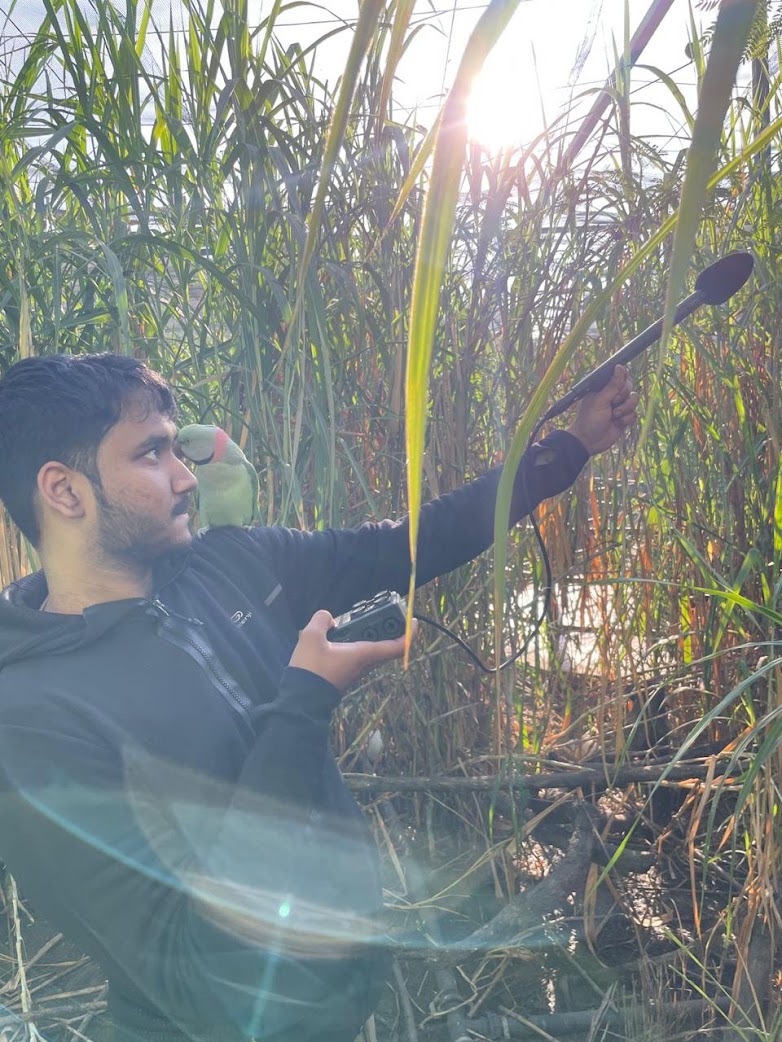
I am proud to be a Princeton EEB PhD student in the Carter Lab. The way I approach animal behaviour was first shaped by the interdisciplinary BS–MS programme at IISER Pune and by my master’s thesis research in the ECEB Lab at JNCASR.
Current
Princeton University
PhD student · Ecology & Evolutionary Biology. Carter Lab · advised by Gerald G. Carter · 2025–present

Scientific training
IISER Pune
BS–MS Dual Degree · Biology. Interdisciplinary undergraduate and master’s training · 2020–2025

From the blog

Field Note
Panama 2026: field recording, caller localization, and acoustic analysis
An account of the 2026 field season, including recording logistics, caller localization, and the relationship between field context and subsequent acoustic analysis. Gatun Lake, Panama · 2026
Project updates
Project updates
Dated records of analyses in progress, revisions to working hypotheses, unresolved methodological decisions, and specific questions for feedback.
Reading syntheses
Literature syntheses
Concise syntheses of related studies, methodological disagreements, evidential limitations, and open research questions.
Methods and resources
Open Tools
Bioacoustic analysis scripts and workflows with reproducible examples, validation notes, documentation, licensing, and citation guidance.
Learning Resources
An annotated collection of tutorials, software, practical workflows, and methods papers for bioacoustics and vocal-sequence analysis.
Selected Publications
Sequence-level vocal convergence in common marmosets
bioRxiv preprint (2026), with Judith M. Burkart and Kaja Wierucka.
Preprint.
Individual-specific associations between warble song notes and body movements in budgerigar courtship displays
Biology Open (2024), with Anand Krishnan.
Paper and First Person interview.
Higher-order dialectic variation and syntactic convergence in the complex warble song of budgerigars
Journal of Experimental Biology (2023), with A. J. Madabhushi, P. Binwal, V. Agarwal, and Anand Krishnan.
Paper.
Site contents
- Research themes, hypotheses, and project-level evidence.
- Peer-reviewed publications, preprints, and clearly labelled work in progress.
- Field notes, analysis updates, and literature syntheses.
- Open methods, reproducible tools, and annotated learning resources.
- A current PDF curriculum vitae.
Want to talk about animal communication?
Send me an email. I am always happy to talk about animal communication, bioacoustics, a dataset, a method, or an idea that is still taking shape. You do not need a formal collaboration proposal—a short note about what caught your interest is plenty.