02
Call combinations & sequence learning
Sequence structure as a learned component of communication
Analyses based on isolated call types omit information carried by order, repetition, timing, and social context. I study how these sequence-level properties vary across individuals and groups, whether they change following social association, and which experimental comparisons are required to establish receiver-relevant function.
Active comparative theme
Last updated 28 August 2026
This page synthesizes peer-reviewed results, public preprints, and preliminary analyses. The evidential status of each result is stated explicitly; preliminary estimates and interpretations may change following validation and review.
Levels of inference
01
Statistical structure
Quantify transition probabilities, repetition, and higher-order dependencies relative to specified null or generative models.
02
03
Functional validation
Compare receiver responses to intact sequences, constituent calls, reordered sequences, and contextually matched controls.
Audience-dependent sequence convergence in common marmosets
In a public marmoset preprint currently in revision, six adults were recorded before the formation of three male–female pairs and again four months later. Following pair formation, partners showed increased sequence similarity when calling to non-partners. This pattern was supported by the combined model and three of four sequence measures; repeat-length distributions did not show a clear change. No comparable convergence was detected in partner-directed sequences. Individual phee-call acoustics showed no clear convergence in either audience context across spectro-temporal, MFCC, constrained dynamic-time-warping, and variational-autoencoder representations.
The audience-specific result is consistent with sequence organization functioning as a pair-level signature expressed toward non-partners. The production data support adult flexibility at the sequence level, but they do not establish receiver perception, shared meaning, or a learned convention.
From continuous variation to provisional sequence units
This cropped, silent screen recording displays an LFCC–UMAP projection, individual spectrograms, and a provisional seven-type classification. Calls from different individuals overlap across much of the projection, indicating that its broad structure is not reducible to individual identity. The categories provide operational units for sequence analysis; they are not a validated repertoire taxonomy.
Transition structure among provisional call types
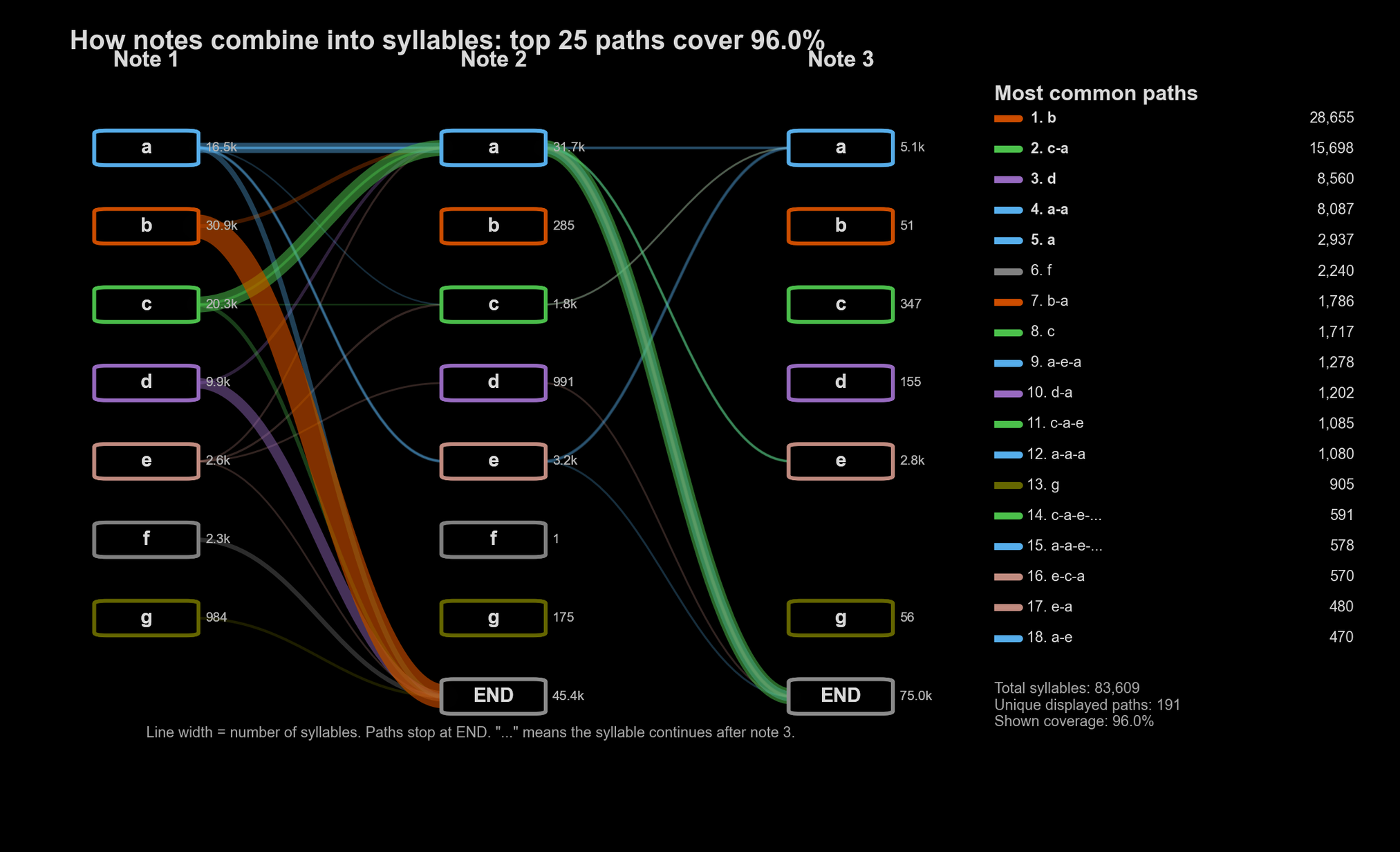
Within a provisional seven-type classification, b frequently terminates a sequence, c frequently precedes a, and a frequently repeats or transitions to e. These descriptive patterns motivate formal tests against sequence null models and analyses of whether particular transitions predict behavioural context or group membership.
Project evidence across species
Have sequences I should know about?
I am especially interested in datasets that link complete vocal sequences to audience composition, behaviour, social relationships, or population history. I would also be happy to talk through experiments using intact combinations and reordered or acoustically matched controls.
Social accommodation
Test whether sequence similarity changes with pair formation, group contact, or other changes in social association.